
A modern tyre can be safer, longer-lasting and more energy-efficient than the product it replaces, yet it is still a resource-intensive composite that wears away while it is used. That makes the honest answer to “Are sustainable tyres here?” less satisfying than a yes or no: the industry is making measurable progress, but no mass-market tyre is impact-free or fully circular.
The environmental footprint is spread across the whole life cycle. Raw materials and manufacturing matter, but so do the energy lost through rolling resistance, the distance a tyre lasts, the particles it sheds, and what happens after removal. A tyre with recycled content is not automatically the best choice if it wears quickly or wastes energy; equally, a low-rolling-resistance tyre is not a complete sustainability solution if its wet safety or longevity is poor.
☰
The short version
- Materials are changing: natural rubber, recycled steel and textiles, recovered carbon black, rice-husk-derived silica and certified circular feedstocks are increasingly entering production.
- The 2030 targets look similar: Michelin, Continental and Bridgestone all use 40% as a key recycled-and-renewable-material milestone, although Bridgestone says it already reached that level in 2025.
- The percentages are not a league table: reporting scopes and chain-of-custody methods differ, and renewable natural rubber already forms part of the total.
- Efficiency during use is crucial: the EU label’s A-to-E fuel-efficiency grade measures rolling resistance, not the tyre’s total environmental footprint.
- Collection is not the same as closed-loop recycling: Europe treats most end-of-life tyres, but a substantial share becomes products other than new tyres or is used for energy recovery.
What manufacturers are promising
The three biggest names in this comparison have converged on remarkably similar long-term language. The detail behind the headline is more revealing:
| Manufacturer | Latest company-reported share | 2030 milestone | 2050 ambition |
|---|---|---|---|
| Michelin | Just over 31% renewable and recycled materials on average | 40% in its tyres | 100% renewable or recycled materials |
| Continental | 28.1% of purchased production materials for tyres in 2025 | At least 40% | 100% “sustainable materials” |
| Bridgestone | 40.0% recycled and renewable materials in 2025 | 40% target level | 100% “sustainable materials” |
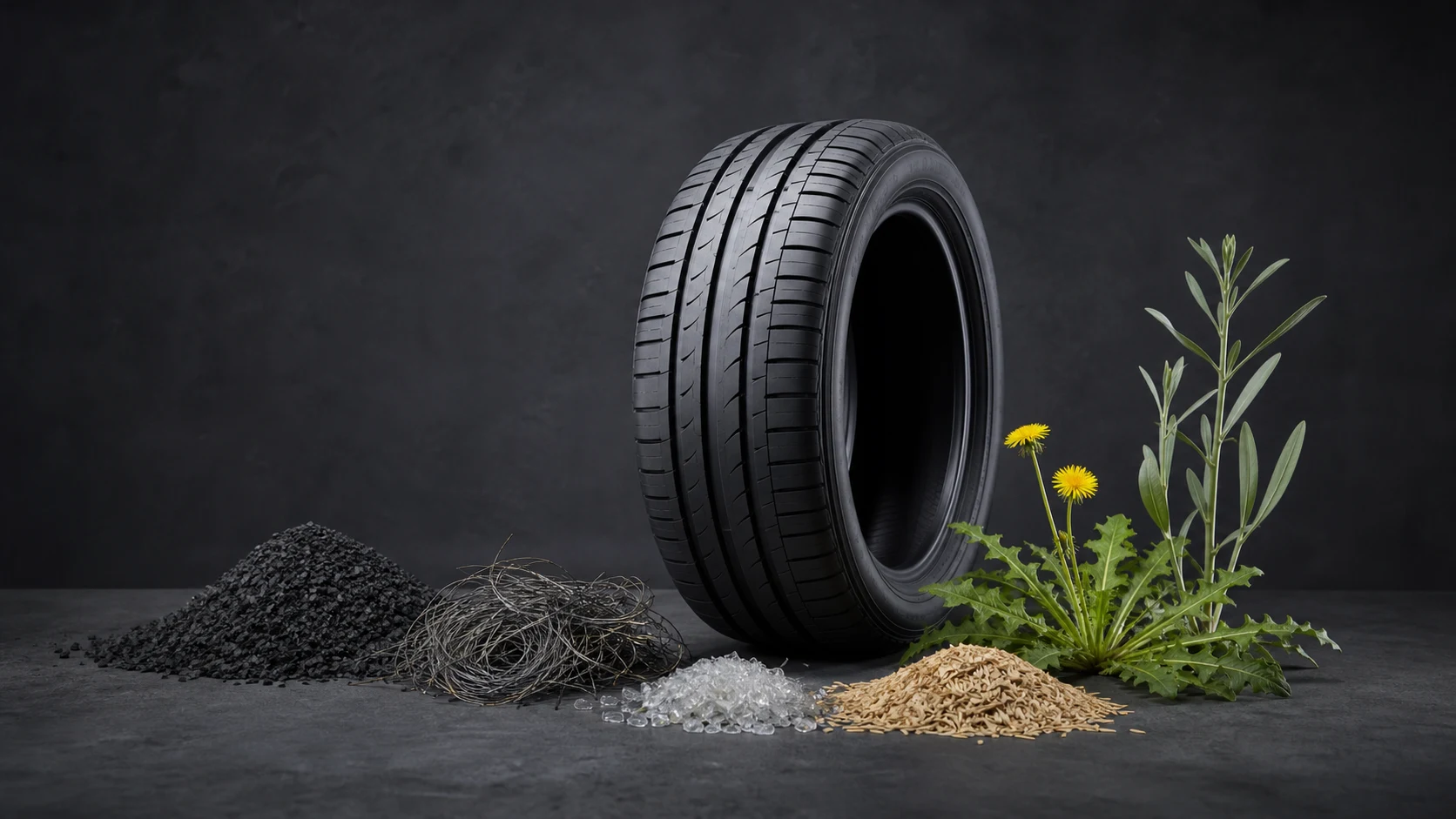
Michelin highlights responsibly sourced natural rubber, bio-based butadiene, recycled steel and textiles, and carbon black recovered from old tyres. Continental lists recycled PET yarn and steel, silica made from rice-husk ash, circular or renewable feedstocks for synthetic rubber and carbon black, and recovered carbon black. Bridgestone’s programme covers many of the same routes, alongside guayule natural rubber, lighter products, longer service life and retreading.
The important caveat is that “renewable and recycled” is not synonymous with “recycled tyre content.” Natural rubber is renewable and can make up a meaningful part of the percentage. It also has its own environmental and social risks, including deforestation, biodiversity loss and traceability across a smallholder-heavy supply chain. The quality of sourcing therefore matters as much as whether a material is biologically renewable.
Why two 40% claims may not mean the same thing
Some material is physically present and separately traceable in a tyre. Other claims use a certified mass-balance approach. In mass balancing, conventional and alternative feedstocks may be mixed in the same supply system; audited bookkeeping then allocates a corresponding quantity of renewable or recycled input to specific products. It is a legitimate way to scale new feedstocks through existing chemical plants, but it does not mean every attributed molecule can be physically traced to the tyre in front of you.
Michelin explicitly described its 2022 road-approved demonstration tyres with 45% and 58% renewable and recycled material as using segregated inputs. Continental and Bridgestone also market products that combine physically recycled or renewable materials with ISCC PLUS mass-balance-certified shares. When comparing products, look for the split between recycled, renewable and mass-balance allocated content rather than relying on one combined number.
Rolling resistance: where the EU label helps
A tyre deforms whenever its contact patch meets the road. Some of that energy becomes heat instead of forward motion: this is rolling resistance. The European Council has estimated that tyres, mainly through rolling resistance, account for 20–30% of a vehicle’s fuel consumption. For an electric car, the same loss reduces range rather than burning fuel at the vehicle.
Under Regulation (EU) 2020/740, the label converts a measured rolling-resistance coefficient into an A-to-E fuel-efficiency class. For a normal passenger-car tyre (class C1), the bands are:
| EU fuel-efficiency class | Rolling-resistance coefficient (N/kN) |
|---|---|
| A | 6.5 or lower |
| B | 6.6–7.7 |
| C | 7.8–9.0 |
| D | 9.1–10.5 |
| E | 10.6 or higher |
The European Commission says one class can represent roughly 80 litres of fuel over an internal-combustion car tyre’s life on average, or tens of kilometres of range per charge for a battery-electric vehicle. Real results depend on the vehicle, driving, load, road, temperature and—critically—pressure.
Do not read the fuel grade alone. The label gives wet grip equal prominence and also shows external rolling noise, plus snow or ice certification where applicable. Engineering one property can affect another, so a sensible shortlist favours strong wet safety and low rolling resistance, then uses independent tests to check braking, aquaplaning, handling and wear. Also check the label for the exact size: different dimensions of the same model can carry different grades.
The label is useful, but it is not a life-cycle score. It does not currently tell you the factory emissions, material origin, recycled share or real-world mileage of a tyre. EU rules are moving towards abrasion and mileage information, while Euro 7 introduces tyre-abrasion requirements, but the familiar shop label should not yet be treated as a complete environmental certificate.
Bio-based rubber: promising research, not one magic crop
Natural rubber from the Hevea brasiliensis tree is already a bio-based tyre material. The research challenge is to diversify supply, improve traceability and replace more fossil-derived synthetic rubber without creating new land-use problems.
- Dandelion rubber: Continental and research partners developed Taraxagum from Russian dandelions. A bicycle tyre reached series production, while the longer-term goal has included passenger and commercial-vehicle applications.
- Guayule: Bridgestone has researched this arid-region shrub since 2012. It has built experimental passenger tyres in which nearly all natural-rubber-containing components used guayule-derived rubber.
- Bio-based synthetic rubber: Michelin’s BioButterfly partnership opened an industrial demonstrator in France to make butadiene—an essential synthetic-rubber building block—from bioethanol instead of petroleum feedstock.
These projects matter because they address different bottlenecks. Alternative plants diversify natural-rubber geography; bio-butadiene tackles the fossil origin of synthetic elastomers. Neither route removes the need for responsible farming, verified carbon accounting, durable tyre design and safety testing at industrial scale.
What actually happens to an old tyre?
EU landfill rules banned whole used tyres from landfill from 2003 and shredded tyres from 2006, with limited exceptions. The European tyre industry now reports a 95% collection and treatment rate for end-of-life tyres. That is important progress—but “treated” covers several very different destinations:
- Reuse and retreading: if the casing is sound, extending its service life preserves more of the original product. Retreading is established for truck and bus tyres but remains limited for passenger cars.
- Mechanical material recovery: shredding and granulation separate rubber, steel and textile. The outputs can enter flooring, construction, moulded products and other uses, although this is often downcycling rather than tyre-to-tyre recycling.
- Pyrolysis or thermolysis: heating tyres without normal combustion can recover oil, gas and recovered carbon black. Michelin, Continental and Bridgestone all support projects intended to improve the quality and scale of these outputs.
- Energy recovery: tyres can replace part of the conventional fuel used in processes such as cement production. It diverts waste from landfill and may displace fossil fuel, but the material is burned rather than kept in a closed loop.
Closed-loop recycling remains the difficult part. In a joint industry paper published in 2023, Michelin and Bridgestone said less than 1% of the carbon black used globally in new tyre production came from recycled end-of-life tyres. Recovered carbon black can reduce demand for virgin petrochemical material, but impurities, consistency, reinforcement performance, supply chains and industrial capacity still limit wider use.
Tyre wear is the sustainability blind spot
A tyre cannot deliver grip without friction, and tread is gradually lost as particles. Collection and recycling only address the material that remains on the wheel at removal; they cannot recover what has already worn onto roads and into the surrounding environment. That is why mileage and abrasion deserve the same attention as recycled content and rolling resistance.
Longer life is not automatically better if it comes from a compound with poor wet grip, just as maximum grip at the cost of rapid wear is not an environmental win. The useful target is safe performance over a long service life with controlled abrasion. Euro 7 creates the framework for tyre-abrasion limits, and EU work on consumer information is expected to make wear easier to compare as test methods mature.
What a driver can do today
- Buy the right category for the job. An efficient touring tyre usually makes more sense for normal road use than a heavy, aggressive or ultra-high-performance design that you do not need.
- Check the exact-size EU label. Prioritise wet grip first, then compare rolling resistance and noise among tyres that meet your safety needs.
- Use independent tests. Look for measured braking, aquaplaning, rolling resistance and wear—not just a sustainability badge or a manufacturer-wide target.
- Protect the service life. Maintain the vehicle-maker’s recommended cold pressure, correct misalignment, inspect uneven wear and avoid unnecessary harsh acceleration and braking.
- Use an authorised collection route. Leave removed tyres with a dealer or approved waste operator so they enter the relevant national recovery system.
The bottom line
Modern tyres are becoming more sustainable in several real ways: more renewable and recycled inputs, lower rolling resistance, better use of agricultural by-products, increasingly traceable supply chains and serious investment in recovering raw materials from old tyres. The common 40% milestones from Michelin, Continental and Bridgestone show that this transition has moved beyond isolated concept tyres.
But the strongest claim is not “green tyre.” It is measurable improvement across the whole life cycle without sacrificing safety. For buyers, the best available proxy is a tyre that suits the vehicle, performs strongly in independent tests, has competitive wet-grip and rolling-resistance labels, lasts well, is maintained correctly and enters a proper recovery system at the end.
Sources and methodology
Manufacturer percentages are company-reported and were checked against the latest material available in July 2026. Because scopes and accounting methods differ, they are presented as progress indicators rather than a ranking.
- Michelin: circular materials, current share, 2030/2050 targets and BioButterfly
- Continental: renewable and recycled materials and mass balancing
- Continental 2025 Annual Report: latest material share
- Bridgestone: circular-material targets, definitions and latest progress
- European Commission: tyre label, rolling resistance and energy impact
- Regulation (EU) 2020/740 on tyre labelling
- Continental: Taraxagum dandelion rubber
- Bridgestone: guayule research
- Tyres Europe: circularity and end-of-life treatment
- EU landfill rules for used tyres
- Michelin and Bridgestone: recovered carbon black and tyre-to-tyre circularity